
PROJECT DAYA (JULY 2025): COMMUNITY HEALTH OUTREACH IN BATAM

From 7 July to 11 July, Project Daya embarked on a community health outreach trip to Batam, Indonesia. During this trip, 12 of us focused on delivering health screenings, health education, and house visits across two kampungs—Kampung Air (KA) and Kampung Punggur (KP).

Partnership with Peduli Bangsa
We were privileged to collaborate with Peduli Bangsa (PB), a local NGO in Batam, who we have collobrated with the past few years, whose volunteers played a vital role throughout the trip. PB volunteers accompanied us during our programs, assisting with translation and helping bridge cultural and linguistic gaps.

At the start of the trip, we conducted a dedicated session with the PB volunteers to familiarize them with our team and our planned activities. This included a mini dry run of the health screenings as well as a walkthrough of the health education materials. Their commitment and enthusiasm greatly enhanced the smooth delivery of our initiatives in the kampungs.

Health Screenings and Education in Kindergartens
Kampung Air (KA)
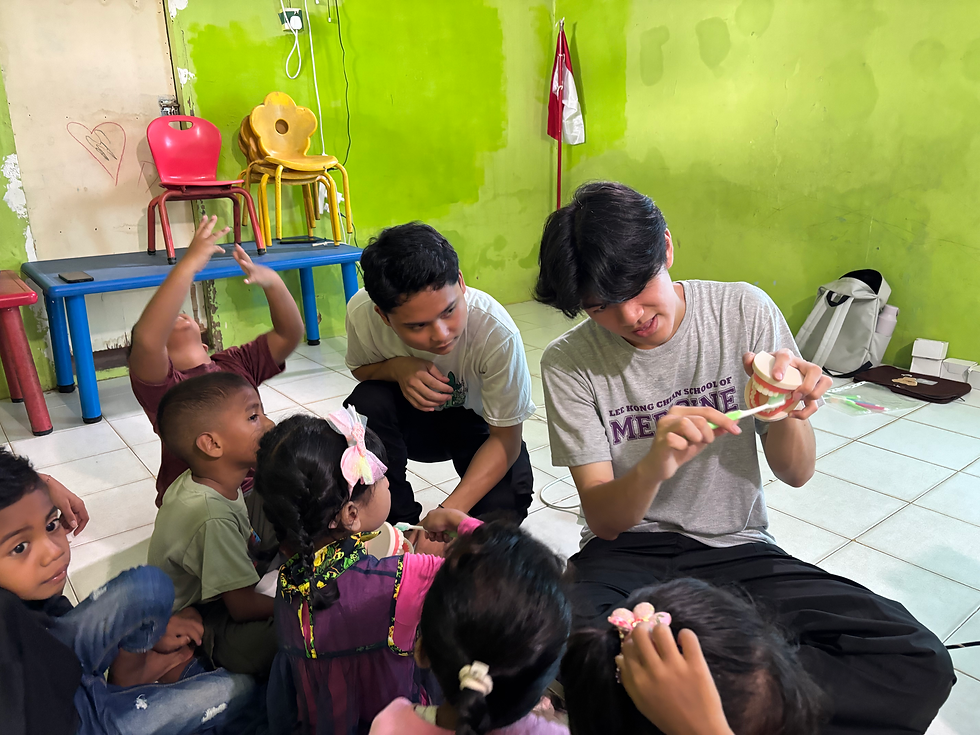
This was our first time conducting a health program in KA, where we screened 58 children aged 4 –14 years. The health screenings included several stations:
Height and weight measurements
General inspection for lice and hand, foot, and mouth disease (HFMD)
Vision tests, including Snellen’s chart and colour blindness screening
Alongside the screenings, we delivered health education sessions covering key topics in mouth hygiene, hand hygiene, and nutrition.

Kampung Punggur (KP)
In KP, we returned for the second time to conduct our health program. We screened 22 children and 16 youths, with the same set of health screening stations as in KA: height and weight, lice and HFMD checks, and vision tests (Snellen’s and colour blindness).
For health education, we structured the sessions separately for different age groups:
For children: topics focused on mouth hygiene, hand hygiene, and nutrition.
For teenagers: sessions covered basic first aid, nutrition, and anti-smoking education—addressing specific health risks more relevant to their age group.

Conducting nutrition education for KP kids 
Daya members Ryan and Ke Wei conducting digital Snellen's test
Concurrent Interviews with Mothers
In both KA and KP, we also conducted interviews with the mothers of the children while the kindergarten programs were ongoing. These conversations provided valuable insights into family health practices and dietary habits, and highlighted the ongoing challenge of malnutrition within both communities.
Follow-up
Following the screenings, we analysed the data and liaised with one of our partner NGOs, YKAN, to ensure follow-up for children identified with lice, HFMD, and those considered underweight. This allowed continuity of care beyond our short stay and provided reassurance that these children would receive further attention and support.
House Visits in Kampung Air
During this trip, our house visits in KA focused primarily on revisits. We sought to follow up with families we had met during the previous two trips, checking in on individuals with specific health conditions that required monitoring.
The visits were designed to be personalized and practical. After conducting simple screenings such as height and weight measurements, blood pressure checks, and medical history-taking, we provided tailored health education. Using brochures, we addressed topics most relevant to each household, such as smoking cessation, the “three highs” (hypertension, hyperlipidemia, and hyperglycemia), gout, and other lifestyle-related concerns.
This personalized approach ensured that our outreach was not only a one-time encounter but also part of a continuing effort to build healthier habits and provide consistent support to the community.

Reflections
A key takeaway from this trip was the value of empowering local partners. The PB volunteers, as Batam locals, were able to connect with beneficiaries in ways that went beyond language translation. Their understanding of the local culture, context, and daily realities allowed our programs to be delivered with greater relevance and impact.
Equally important was the role of follow-up partners like YKAN, whose involvement ensured that children identified with conditions such as lice, HFMD, or undernutrition would continue to receive attention beyond our immediate visit. These partnerships underscore how sustainable community health initiatives rely not only on external outreach but also on local collaboration and continuity of care.
By combining screenings, targeted education, and home visits—with the support of PB and YKAN—Project Daya was able to address both immediate health concerns and broader, long-term issues such as malnutrition and lifestyle risks. Our experience in Batam reaffirmed our commitment to community-based health initiatives, and we look forward to continuing collaborations that bring healthcare closer to those who need it most.


